Turning Customer Voice Into Product Intelligence
An AI engine that makes the customer's voice a member of the product team.
View live product →Extracting customer insight from pre-sales calls meant listening manually, and only ever covered a few hundred conversations, so feature requests and pain points went unheard. I designed and built SleeperCell, an AI-powered customer intelligence engine that transcribes and analyses thousands of calls in one click, turning recordings the business already had into structured, searchable product insight.
Context
The Sleep Company runs thousands of pre-sales conversations: customers calling in, walking into stores, describing exactly what they need before they buy. Every one of those calls is, in effect, a product brief written by the customer: the pain that brought them in, the feature they wish existed, the competitor they almost chose, the thing that nearly stopped the sale.
All of that signal already existed inside call recordings. The business had paid to generate it. But it was never turned into product decisions, because the only way to mine it was for someone to sit and listen. Customer research meant calls, store visits, and manual note-taking, which capped insight at whatever a human could process in a week.
I took this on as a self-initiated build. The goal was not a research report, but permanent infrastructure: a way to make the customer's voice a standing input into how the company decides what to build.
- ·The Sleep Company receives 10,000+ customer pre-sales calls every month
- ·Each call carries real, unfiltered product signal
- ·Constraint: insight was capped by manual listening capacity
Data Discovery
I mapped the existing research workflow against the volume of calls coming in, and the gap was the whole story. Manual review realistically covered a few hundred conversations; thousands more went unexamined. The number of product decisions actually informed by call data was, effectively, zero, not because the data was bad, but because nothing could read it at scale.
The obvious fix was to reach for AI transcription and analysis tools. But the tools that could handle this volume were not free, and the ones that were free had hard limits. Even models like Claude cap how much transcript text they will process in one pass, which means transcribing 10,000 calls a month and then analysing them would either blow through a paid API budget fast, or require batching and manual orchestration that recreated the bottleneck in a different form.
Listening to a sample of calls myself, I found the same signals recurring: customers naming a competitor, describing a pain in their own words, asking for a feature that did not exist, hesitating at a price. These were not edge cases. They were patterns obvious at scale and invisible at a sample of a few dozen. The problem was not a lack of signal. It was a pipeline that could handle the volume without cost becoming the new constraint.
Strategic Thinking
I framed the product around a single conviction: the customer is king, and their voice should be the company's best product team. The strategic bet was that the highest-leverage thing I could build was not another dashboard, but a way to hear every customer instead of a hand-picked few.
Two design constraints shaped every decision. First, it had to be free to run and free of data risk: call recordings are sensitive, so the pipeline runs locally and nothing leaves the machine. Second, it had to be one click. Any tool that required setup or manual triage would simply recreate the manual bottleneck it was meant to remove.
I deliberately scoped it as an internal intelligence layer rather than a one-off analysis. If it worked, it could feed product reviews, CX follow-ups, and leadership decisions on an ongoing basis, so I designed the output for those audiences from the start.
- ·Bet: hear every customer, not a sampled few
- ·Run locally: zero cost, zero data leaving the machine
- ·One click: no setup, no manual triage, no new bottleneck
Solution
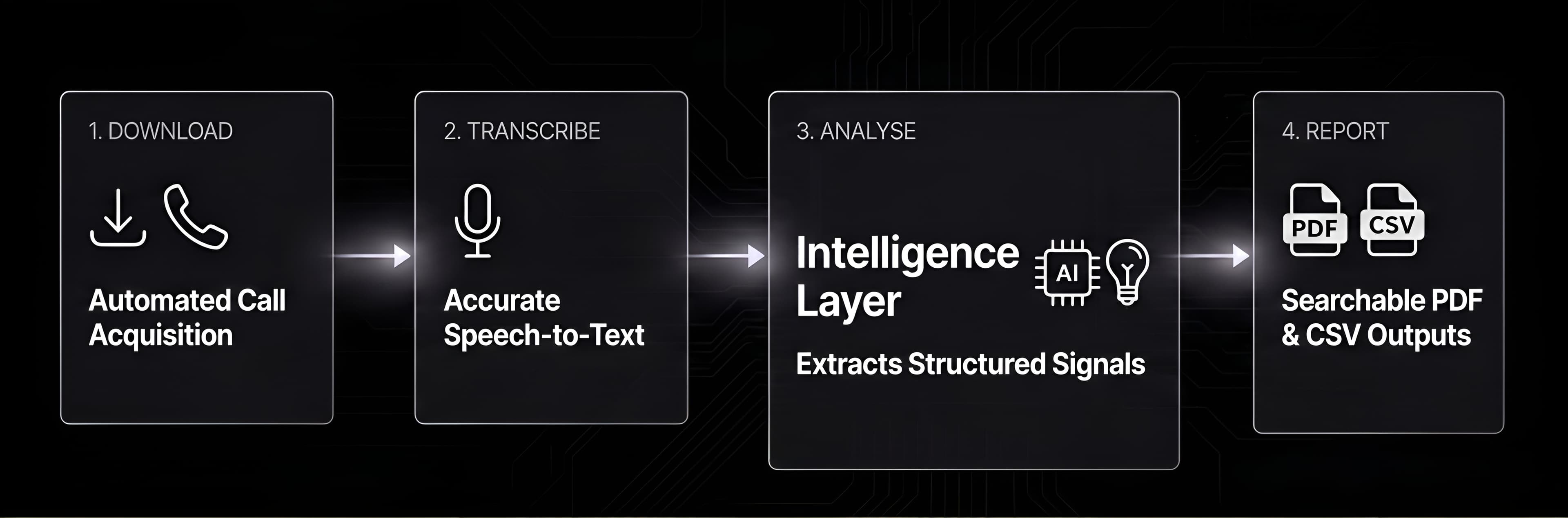
SleeperCell is a four-stage pipeline: download recordings, transcribe via Groq Whisper, run local AI analysis to extract 12 structured signals per call, and output a shareable PDF and CSV report.
Everything runs locally. No data leaves the machine, no API costs at scale.
- ·Four-stage pipeline: Download → Transcribe → Analyse → Report
- ·12 structured signals extracted per call, zero marginal cost
- ·Searchable transcripts, AI summaries, PDF + CSV export
Validation & Testing
I validated the core hypothesis the only way that mattered: by pointing the pipeline at real call recordings and seeing whether the extracted signals matched what a careful human listener would conclude. They did; the engine surfaced the same competitor mentions, pain points, and feature requests I had found by hand, across a far larger sample than I could ever review manually.
I tested the framing with the people who would use the output. Structuring SleeperCell around four audiences (Product, CX, Leadership, and the Customer) let me check that each group could see themselves in it: product sees what to build next, CX sees which customers had unmet needs, leadership gets real signal in every product review.
The clearest proof was the throughput delta. The same effort that previously yielded insight from a few hundred calls now yielded structured intelligence from thousands, with the marginal cost of an additional call effectively zero.
Outcomes
SleeperCell turns recordings the company already had into a standing stream of product intelligence. With one click it transcribes thousands of customer calls and returns structured insights: pain points and feature requests visible at a sample size that was never previously possible, all at zero cost and with no data leaving the machine.
The strategic outcome is bigger than any single report: it lays the foundation for an internal customer intelligence layer. If scaled, every product decision can be checked against what real customers actually said, on real calls, moving the organisation from opinion-led to genuinely customer-led product development.